The transition from dreaming about independence to actually signing the lease on a storefront or filing articles of incorporation is one of the most exhilarating—and terrifying—phases of a career. Starting your first business isn’t just about a great idea or a passion for a specific craft; it is an exercise in infrastructure, risk management, and the relentless pursuit of operational efficiency.
Most first-time founders fail not because their product was poor, but because they underestimated the “boring” parts of business: the legal compliance, the utility logistics, the technical overhead, and the sheer volume of physical management required to keep a company running. This guide is designed to take you beyond the surface-level advice of “finding your why” and into the granular, actionable realities of building a business that lasts. We will explore how to protect your assets, manage your physical site, and build a technical foundation that scales with your ambition.
Validating the Concept and Revenue Model

Before you spend a single dollar on branding or inventory, you must prove that your business has a heartbeat. Market validation is the process of confirming that people are willing to pay for your solution at a price point that covers your costs and leaves room for profit. Too many entrepreneurs build in a vacuum, only to realize upon launching that their “revolutionary” idea solved a problem that didn’t exist or was already addressed by cheaper alternatives.
Testing Market Demand Before Investing
-
Conducting Micro-Tests: Use landing pages with “coming soon” sign-ups to gauge interest levels in specific geographical areas.
-
Competitor Gap Analysis: Don’t just look at what competitors are doing right; look at where they are failing. Read their negative reviews to find the “pain points” you can solve.
-
The MVP Approach: Build the simplest version of your service first. If you want to start a catering empire, start by selling individual meals at a local market to test your recipes and pricing.
Strategic Capital Raising
Financial forecasting is often where the excitement of a new venture meets the cold reality of math. You need to account for your “burn rate”—the amount of money you spend each month before you become profitable. While traditional loans are an option, many modern founders are looking at community-driven ways to bridge the initial gap.
One effective way to generate buzz and initial funding is through a pop-up fundraiser. This model focuses on high-energy, short-duration events that encourage local supporters to contribute to your startup costs in exchange for early access or founding-member perks. It serves a dual purpose: it provides immediate liquid capital and creates a built-in customer base that feels personally invested in your success.
Legal Foundations and Professional Protection
Setting up your business correctly from a legal standpoint is the most important insurance policy you will ever have. While it is tempting to use DIY online forms to save money, the nuances of your specific industry often require a more tailored touch. A mistake in your operating agreement or a failure to properly register for state taxes can result in personal liability that could haunt you for years.
Structuring for Scalability and Safety
Choosing your business structure—whether it’s a Limited Liability Company (LLC) or a corporation—dictates how you are taxed and how much of your personal assets are at risk.
-
Separation of Assets: Always maintain a strict line between personal and business finances. Even if you are a sole proprietor, a separate bank account is non-negotiable.
-
Operating Agreements: If you have partners, you must have a “business pre-nuptial” that outlines how decisions are made and what happens if someone wants to leave the company.
Navigating Compliance and Local Regulations
Every municipality has its own web of red tape. From zoning laws that prevent you from running a warehouse out of your garage to health department codes for food prep, staying compliant is a full-time job. This is where building a relationship with local attorneys becomes invaluable. These professionals understand the specific quirks of your city’s regulatory environment and can help you navigate permit applications that might otherwise take months to process. Having legal counsel on retainer ensures that when you receive a “cease and desist” or a contract dispute, you aren’t scrambling to find help while your business is at a standstill.
Establishing a Physical and Digital Presence
In today’s economy, your business needs to exist in two places at once: the physical world and the digital landscape. Even if you are a “bricks and mortar” shop, your digital footprint is often the first point of contact for your customers. Conversely, even if you are an online-only brand, the physical space where you work impacts your productivity and legal standing.
Infrastructure for the Modern Workforce
The traditional long-term office lease is no longer the only way to do business. For many service-oriented startups, agility is the key to survival. Utilizing a mobile office can be a game-changer for businesses that need to be on-site with clients, such as construction, mobile grooming, or event planning. This allows you to bring your administrative headquarters directly to the point of sale, reducing travel time and overhead costs associated with a stationary building.
Securing Your Digital Assets
Your data is just as valuable as your physical inventory. A single data breach or a server failure can wipe out years of progress and destroy customer trust. As you grow, managing your own hardware and software becomes increasingly complex.
Partnering with a reliable IT company is a strategic move that allows you to focus on your core business while experts handle your network security, cloud backups, and software integrations. They can help you implement robust firewalls and ensure that your customer payment information is handled according to industry standards. In a world where cyber-attacks on small businesses are rising, professional technical oversight is a necessity, not a luxury.
Operational Logistics and Site Management
If your business involves a physical location—whether it’s a retail shop, a warehouse, or a construction site—logistics will take up a significant portion of your mental bandwidth. Managing the “invisible” needs of a workspace is what separates a professional operation from an amateur one.
Managing Large-Scale Utility Needs
For businesses operating in developing areas or on temporary sites, standard municipal utilities aren’t always available from day one. You may find yourself needing to coordinate bulk water delivery to sustain your operations, especially for landscaping, construction, or large-scale event hosting. Planning for these deliveries requires a keen understanding of your daily consumption rates and the storage capacity of your on-site tanks.
-
Audit your needs: Calculate your peak usage days to ensure you never run dry.
-
Contract Reliability: Ensure your delivery partner has a contingency plan for emergency refills.
Waste Management and Environmental Responsibility
A cluttered or dirty workspace is a liability. It creates safety hazards for your employees and projects an image of unprofessionalism to your clients. You need a systematic approach to getting rid of the waste your business generates. Setting up recurring trash pick-up services is the first step in maintaining a baseline of cleanliness. However, don’t just settle for the most basic plan; look for providers that offer recycling and hazardous waste disposal if your business handles chemicals, electronics, or large amounts of packaging.
Specialized Infrastructure and Maintenance
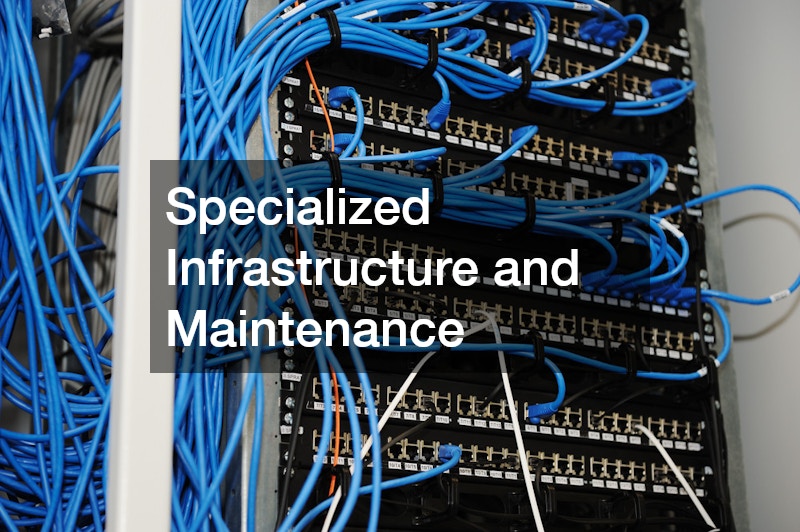
As your business grows, the systems that power it will become more complex. You cannot afford to “wing it” when it comes to the technical systems that keep your lights on and your products safe.
Powering Your Growth Safely
Electricity is the lifeblood of almost every modern business. From powering high-end computers to industrial machinery, your electrical grid must be robust and compliant. Attempting to handle complex wiring yourself is a recipe for fire hazards and insurance denials. Engaging certified electricians for all your installation and repair needs is critical. They ensure that your circuits are not overloaded and that your facility meets the National Electrical Code (NEC).
-
Dedicated Circuits: Ensure high-draw equipment is on its own circuit to prevent outages.
-
Surge Protection: Protect your expensive hardware with industrial-grade surge suppression installed at the main panel.
Specialized Cooling and Climate Systems
For businesses in the food, beverage, or medical industries, temperature control is a matter of survival. If a walk-in freezer fails, you could lose tens of thousands of dollars in inventory in a single afternoon. This is why establishing a relationship with professional commercial refrigeration services is vital. These specialists don’t just fix broken machines; they provide the preventative maintenance—such as cleaning coils and checking refrigerant levels—that prevents breakdowns from happening during a heatwave or a busy holiday weekend.
Scaling the Physical Workspace
Eventually, you may find that your initial space is no longer sufficient. Whether you are renovating an old building or expanding your current footprint, construction logistics are notoriously difficult to manage.
Handling Debris and Renovation
Expansion is messy. Whether you are tearing down walls to create an open-plan office or clearing out a basement for extra storage, you will generate more waste than a standard bin can handle. Utilizing dumpster rentals during these transition periods is the most efficient way to keep your site clear. It allows your team to dispose of construction debris, old furniture, and packaging in real-time, preventing the “piling” effect that leads to accidents and slows down contractors.
-
Size Matters: Always rent a slightly larger dumpster than you think you need; “air space” in a dumpster is cheaper than paying for a second haul.
-
Permit Check: Ensure you have the right to place a large container on the street or in your parking lot before it arrives.
Fluid Systems and Sanitary Requirements
Just as electricity and refrigeration are specialized, so is the movement of water and waste within your building. Commercial plumbing is vastly different from residential plumbing; the pressures are higher, the usage is more frequent, and the codes are stricter. When you are building out your space, vetting various plumbing companies for their commercial experience is essential. You need a partner who understands grease traps for kitchens, high-capacity drainage for industrial uses, and the specific ADA requirements for public restrooms.
Building a Resilient Operations Strategy
The Human Element
While the sections above focus on the “hardware” of your business, the “software” is your people. As you hire your first employees, your role shifts from “doer” to “leader.” This means you need to document every process you’ve created. If a pipe bursts, does your manager know which of the plumbing companies you use? If the internet goes down, do they have the direct line to your IT company?
-
Standard Operating Procedures (SOPs): Write down how every task is performed.
-
Cross-Training: Ensure more than one person knows how to handle critical utility issues or emergency contacts.
Financial Longevity
A business is a living entity that breathes cash. The moment you stop monitoring your cash flow is the moment the business begins to die. Use the first year to build a “war chest.” This is a reserve of capital that is never touched except in the case of a true emergency—like a global supply chain disruption or a sudden need for major facility repairs.
-
The 10% Rule: Aim to set aside 10% of all gross revenue into a high-yield savings account until you have six months of operating expenses.
-
Negotiate Everything: From your trash pick-up services to your lease terms, everything is a conversation. Don’t be afraid to ask for better rates as a loyal, long-term client.
Starting your first business is a monumental undertaking that requires a blend of vision and pragmatism. It is easy to get lost in the excitement of a new logo or a viral marketing campaign, but the businesses that stand the test of time are those built on a rock-solid foundation. This means taking the time to consult with experts—from the people who wire your building to the ones who defend your legal rights.
As you move forward, remember that every challenge is simply a data point. A broken refrigerator is an opportunity to find a better maintenance partner. A legal hurdle is a chance to tighten your contracts. A funding gap is a reason to engage your community more deeply. By focusing on the infrastructure, the safety, and the systems of your operation, you aren’t just starting a job for yourself; you are building an asset that can provide value for years to come. Stay diligent, stay curious, and keep your eyes on both the big picture and the smallest utility bill. Success is the result of a thousand small things done correctly.